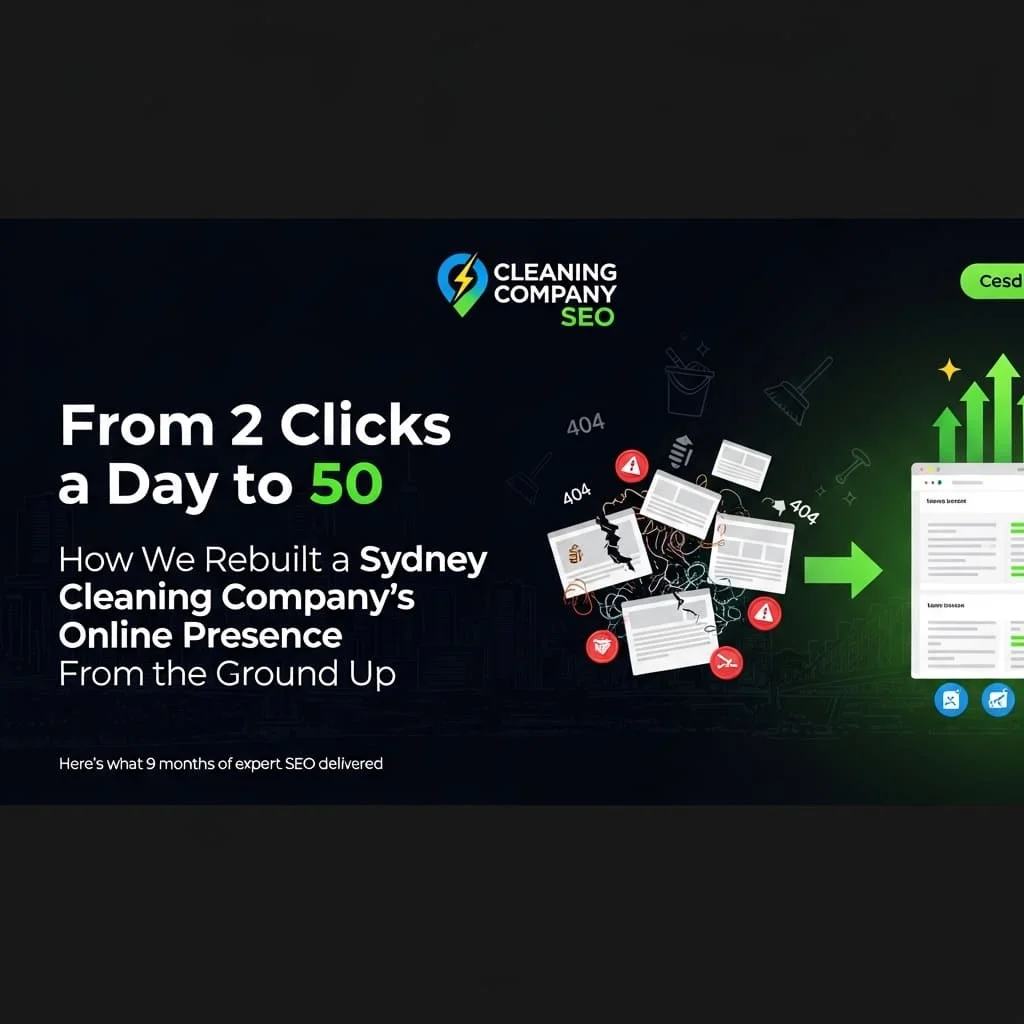
From 2 Clicks a Day to 50

How We Rebuilt a Sydney Cleaning Company’s Online Presence From the Ground Up

Here’s what 9 months of expert SEO delivered.

Industry: Cleaning Services (Multi-Service, Single City) Location: Sydney, Australia Project Duration: 9 Months Services Delivered: Technical SEO · Site Architecture · On-Page SEO · Local SEO · Google Business Profile Optimisation · Schema Markup · Content Strategy · Off-Page SEO

RESULTS AT A GLANCE

Metric

Before (Month 1)

After (Month 9)

Daily Organic Clicks

~2 clicks/day

~50 clicks/day

Monthly Qualified Leads

Near Zero

30–50 leads/month

Total Annual Clicks

Negligible

2,990 clicks

Total Annual Impressions

Negligible

1,080,000 impressions

Average Ranking Position

65.3

14.3

Active Users Growth

Baseline

+3,768%

Key Events (Conversions)

Baseline

+23,204%

Introduction

Most cleaning company websites don't fail because they lack content.

They fail because the content they have was built without any strategy — and over time, that chaos compounds into an invisible, underperforming digital asset that costs money to host and delivers nothing in return.

That’s exactly the situation we inherited when a multi-service cleaning company based in Sydney, Australia, approached us nine months ago.

Their website had over 1,800 pages. They offered a wide range of cleaning services across Sydney. And despite all that scale — the website was generating almost no organic traffic and virtually zero leads.

The problems weren’t just technical. They ran through every layer of the site: its structure, its content, its local presence, and its authority.

This is the story of what we found, what we fixed, and what the data looks like today.

The Challenge

1,800 Pages. Almost No Results. Here's Why.

When we conducted our initial audit, we weren’t looking at one or two problems. We were looking at a website that had been built in layers — service after service, page after page — without any underlying plan. Every problem we uncovered was connected to another.

Here is the full picture of what we were dealing with:

Doorway Pages — Built to Game Google, Penalised by Google

The site was heavily reliant on doorway pages — low-quality, near-duplicate pages created purely to target specific keyword combinations, not to genuinely serve users. Google explicitly penalises this practice. These pages were suppressing the entire domain’s credibility in search.

Wrong URL Structure & Broken Site Architecture

There was no logical URL hierarchy. Pages were created ad hoc, with inconsistent naming conventions and no clear relationship between parent services, child services, and location pages. Google had no coherent map of the site to crawl — and neither did users.

Severe Keyword Cannibalization

This was one of the most damaging issues. Multiple pages were targeting the same or nearly identical keywords — service pages competing with location pages, suburb pages competing with each other, and category pages overlapping with individual service pages.

When your own pages compete against each other, none of them win. Google gets confused about which page to rank and typically ranks all of them poorly as a result.

No Research, No Planning, No Strategy Behind the Content

The pages had been created reactively — someone wanted to target a suburb or a service and a page was created. There was no keyword research, no search intent analysis, no content planning. The result was a site full of pages that didn’t match what real customers were actually searching for.

Serious Technical SEO Issues

Beyond the structural problems, the site had a range of critical technical issues: crawl errors, improper indexation signals, slow load times, poor mobile performance, and pages that should have been indexed sitting excluded — and pages that should have been excluded consuming crawl budget.

No Schema Markup

Not a single structured data implementation existed on the site. No LocalBusiness schema. No Service schema. No review markup. Schema markup helps Google understand what a page is about and can significantly improve click-through rates through rich results in search. The site had none of it.

No Google Business Profile Optimisation

The Google Business Profile — one of the most important local SEO assets for any service business — had been left incomplete and unoptimised. For a cleaning company competing in a dense urban market like Sydney, this was a significant missed opportunity for local map pack visibility.

Almost Zero Quality Backlinks

The site had virtually no authoritative, relevant backlinks pointing to it. Without external signals of trust and relevance, Google had no reason to prioritise this website over established competitors in Sydney’s competitive cleaning market.

No NAP Consistency

Name, Address, and Phone number — the foundational trust signals of local SEO — were inconsistent across online directories, listings, and the website itself. This inconsistency actively undermines local search rankings.

No Blog or Topical Authority Content

There was no content strategy. No blog. No educational content. No effort to build topical authority in the cleaning services space. The site was a collection of service pages with nothing to signal to Google that this was a genuine, knowledgeable business worth ranking at the top of Sydney searches.

Our Strategy & Solution

We Didn't Just Fix Problems. We Rebuilt the Foundation.

This project required deep expertise across Technical SEO, Site Architecture, On-Page Optimisation, Local SEO, and Content Strategy — all executed in the right sequence. Here is exactly what we did and why.

Phase 1: Full Technical & Structural Audit

Before touching a single page, we mapped the entire site. Every URL. Every redirect. Every error. Every duplicate. Every cannibalisation conflict.

This audit gave us a clear prioritised plan — so we were solving the right problems in the right order, not just patching issues randomly.

Phase 2: Eliminating Doorway Pages & Fixing URL Structure

We systematically identified and removed all doorway pages — consolidating their value where possible into properly structured, user-first pages.

Simultaneously, we redesigned the entire URL structure to create a clean, logical hierarchy:

Service Category → Specific Service → Location

This gave Google a clear, crawlable map of the site — and gave users a clear, intuitive path to finding what they needed.

Phase 3: Resolving Keyword Cannibalization

Every cannibalisation conflict was documented and resolved. This meant:

  • Merging overlapping pages where appropriate
  • Clearly differentiating pages that needed to remain separate through distinct keyword targeting
  • Implementing canonical tags where needed
  • Restructuring internal linking so each target keyword had one clear, authoritative page behind it

Once Google knew exactly which page to rank for each search query — the rankings began to move.

Phase 4: Resolving All Critical Technical SEO Issues

With the structure corrected, we worked through every technical issue on the site:

  • Corrected indexation signals — the right pages indexed, the wrong pages excluded
  • Resolved crawl errors and improved crawl efficiency
  • Optimised page speed and Core Web Vitals
  • Rebuilt XML sitemaps and submitted fresh crawl requests through Google Search Console
  • Fixed internal link structures to ensure proper equity flow throughout the site

Phase 5: Schema Markup Implementation

We implemented comprehensive structured data across the entire site:

  • LocalBusiness schema on key pages — communicating the business’s name, location, services, and contact details directly to Google
  • Service schema on all individual service pages
  • FAQPage schema on relevant pages to increase SERP real estate and click-through rates
  • BreadcrumbList schema to reinforce site architecture signals

Schema markup doesn’t just help rankings — it helps the right people click through from the results.

Phase 6: Google Business Profile Optimisation

We conducted a full Google Business Profile (GBP) overhaul:

  • Completed all profile sections with accurate, keyword-rich business information
  • Added all relevant service categories
  • Uploaded high-quality photos and business imagery
  • Developed a consistent review generation strategy
  • Ensured perfect NAP alignment between the GBP and the website

For a cleaning company in Sydney, local map pack visibility is often where the highest-intent customers find you. We made sure this client was positioned to capture that traffic

Phase 7: NAP Consistency Across All Listings

We audited every online directory, citation source, and listing platform where this business appeared.

Every inconsistency in name, address, and phone number was corrected. New citations were built on authoritative Australian business directories. This consistency sends a strong local trust signal to Google, and it matters more than most business owners realise.

Phase 8: Topical Authority & Blog Content Strategy

The final phase was building long-term authority through content.

We developed a full topical map — identifying every question, concern, and search intent a Sydney cleaning customer might have at any stage of their decision process.

From this, we built a structured blog and content plan:

  • Educational articles targeting high-intent informational queries
  • Service comparison content helping customers choose the right cleaning type
  • Local content establishes the business as Sydney’s go-to cleaning authority
  • Internal linking from blog content back to core service pages, amplifying their authority

This content doesn’t just generate traffic — it builds the kind of topical depth that earns Google’s long-term trust.

Results:

The Data Tells the Story. Here It Is.

Click Growth: From 2 to 50 Per Day

At the start of the project — May 2025 — the website was receiving approximately 2 clicks per day with 1,132 impressions and sitting at an average position of 65.3. Effectively invisible.

By April 2026, the same website recorded 48 clicks in a single day, with 8,909 impressions and an average ranking position of 14.3 — a near 50-point improvement in average position.

Over the full 12-month tracking window, the website accumulated:

  • 2,990 total organic clicks
  • 1,080,000 total impressions

Average CTR: 0.3% (with significant room to grow as rankings move to page one)

Google Analytics: Traffic & Conversion Explosion

The Google Analytics data tells an even more striking story of transformation: Active Users: 5,300 — up 3,768% compared to the previous period New Users: 5,300 — up 3,742% Key Events (Leads/Conversions): 5,600 — up 23,204% Event Count: 148,000 — up 2,056% That conversion growth figure — 23,204% — is not a typo. It reflects a website that went from generating almost zero meaningful user actions to consistently producing qualified leads: phone calls, form submissions, and booking requests from real Sydney cleaning customers.

Monthly Qualified Leads: 30–50 Per Month

The business outcome of all this data is straightforward: The client is now receiving 30 to 50 qualified leads per month through organic search — customers actively searching for cleaning services in Sydney, finding this business, and reaching out. No Google Ads. No paid social. Pure organic growth. At an average cleaning job value of $200–$350, 30–50 leads per month at even a conservative 40% close rate represents a monthly organic revenue contribution of $2,400–$7,000 in new bookings — and growing every month as rankings continue to improve.

Position Movement: From Page 7 to Approaching Page 1

Average position moved from 65.3 to 14.3 — meaning the site went from sitting on page 6–7 of Google results (where virtually no one clicks) to the bottom of page one and top of page two — the tipping point where clicks and leads accelerate dramatically. As content authority continues to build, these rankings are set to push further up page one.

Key Takeaways

What Every Cleaning Company Owner Needs to Understand
  1. More pages do not mean more traffic. 1,800 pages with no strategy generated 2 clicks a day. A properly structured, strategically optimised site generates 50, and that number keeps growing. Quality and structure always beat volume.
  2. Keyword cannibalization is silent and deadly. Most cleaning company owners have never heard of it. But if your own pages are competing against each other in Google, none of them will rank well. Fixing this alone can unlock significant ranking improvements.
  3. Google Business Profile is not optional for local businesses. For a service business operating in a specific city, your GBP is often the first thing a customer sees. An incomplete, unoptimised profile is leaving local map pack visibility and leads on the table every single day.
  4. Schema markup gives Google clarity — and clicks. Structured data implementation is one of the highest-leverage, lowest-effort improvements most cleaning company websites are missing. It helps Google understand your pages and helps your listings stand out in search results.
  5. NAP consistency is a trust signal you can’t ignore. Inconsistent business information across directories tells Google your business is unreliable. Fixing it is unglamorous work, but it moves the needle on local rankings.
  6. Topical authority is how you win long-term. Service pages get you found for specific queries. Blog content and topical depth get you trusted as an authority, and that trust compounds into rankings that are very hard for competitors to displace.
  7. This kind of transformation requires real expertise. This wasn’t a quick fix. It required a skilled team working across technical SEO, site architecture, local SEO, content strategy, and off-page authority, all coordinated over nine months. The results reflect that investment.

Conclusion

Nine months ago, this Sydney cleaning company had a website that was working against them.

1,800 pages of doorway content, keyword cannibalization, technical errors, no local SEO presence, no schema, no backlinks, and no content strategy. Google barely knew the site existed.

Today, the same business is generating 30–50 qualified leads every single month from organic search. Daily clicks have grown from 2 to 50. Impressions have crossed 1 million over the past 12 months. And key conversion events are up over 23,000%.

That’s not a marketing claim. That’s Google’s own data.

The transformation happened because every layer of the problem was addressed — in the right order, with the right expertise. Technical first. Structure second. Content and authority third. Local presence throughout.

This is what specialised SEO looks like for a cleaning business.

And if your website is generating less than it should — fewer calls, fewer quote requests, fewer bookings than your business deserves, there’s a very high probability that one or more of these exact problems is holding you back right now.

Ready to Turn Your Website Into a Lead Machine?

We work exclusively with cleaning companies. House cleaning. Commercial cleaning. Carpet cleaning. End of lease. Pressure washing. Window cleaning. Across Australia, the USA, Canada, and the UK.

We know your customers. We know your competition. We know exactly what Google needs to see to rank a cleaning business at the top of local search results.

A free strategy call costs you nothing. A website that doesn’t generate leads costs you every single month.